

At some point, most families face a deeply personal crossroads. A parent or loved one starts needing help — not necessarily medical attention, but just more day-to-day support to stay safe and comfortable. That’s when the question arises: home care vs assisted living — which makes more sense for our family?
It’s a sensitive conversation because it touches on independence, safety, and even identity. Both options can be life-changing, but they meet different needs and personalities. The real challenge is understanding which one truly fits your loved one’s situation — and doing so with compassion, not pressure.
This guide unpacks both choices in practical terms, with a focus on when non-medical home care can provide the flexibility, familiarity, and emotional stability many families are seeking.
The Basics: What Each Option Actually Means
Before comparing home care vs assisted living, it helps to define what each really means — beyond the brochures and assumptions.
What Is Home Care (Non-Medical)?
Home care is about bringing personalized support directly into someone’s home. It’s flexible, private, and centered on helping people remain independent longer. Caregivers assist with essential daily activities such as:
- Personal hygiene and grooming
- Meal preparation and light housekeeping
- Medication reminders
- Mobility support or accompaniment to appointments
- Simple companionship and conversation
Crucially, non-medical home care focuses on maintaining lifestyle and dignity rather than delivering medical treatments. It works best for individuals who want to stay where they feel most comfortable — among familiar things, family memories, and community.
What Is Assisted Living?
Assisted living, on the other hand, offers housing combined with support services in one facility. Residents live in private or semi-private apartments, with staff on-site to help with meals, housekeeping, and personal care as needed. Many facilities also offer social activities, transportation, and wellness programs.
It’s a good option for individuals who prefer structured schedules, built-in social engagement, and oversight around the clock — especially if living alone has become isolating or unsafe.
Assisted living and home care both serve important roles. The real difference lies in how they balance independence, comfort, and control.
Comparing Day-to-Day Realities

Here’s where the “home care vs assisted living†question becomes tangible. It’s not just about service checklists — it’s about lifestyle, psychology, and family rhythms.
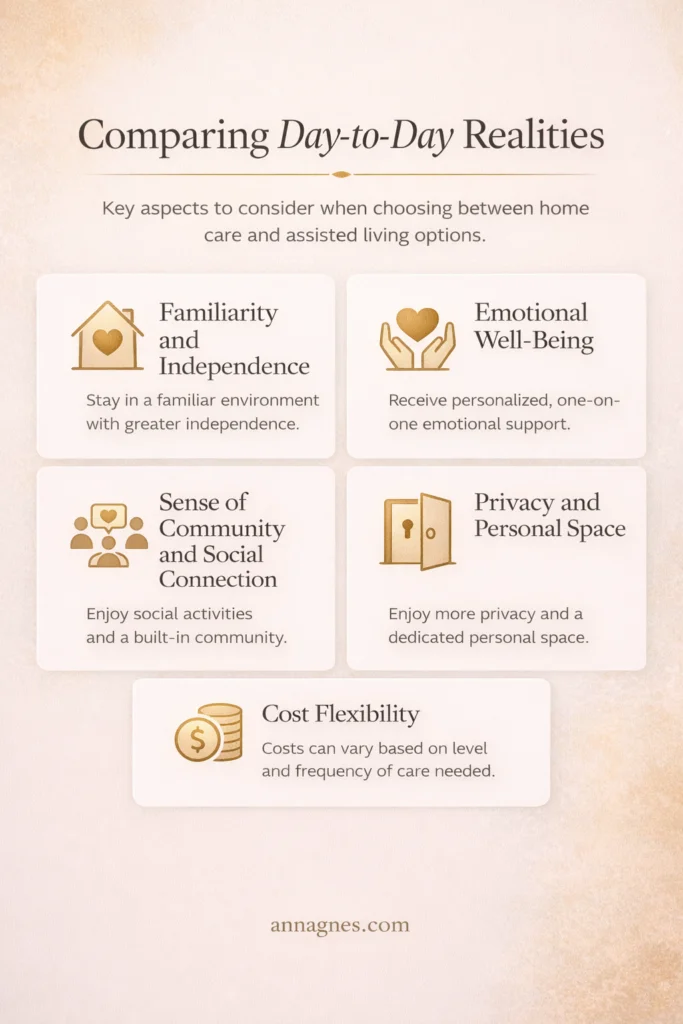
1. Familiarity and Independence
In home care, the rhythm of life stays much the same. Meals happen in the same kitchen. Favorite TV shows air in the same living room. A caregiver blends into an existing routine rather than replacing it.
With assisted living, there’s more structure — meals at set times, planned activities, and shared spaces. Some find this reassuring; others miss the spontaneity and fully private environment of home.
Neither is inherently better — it’s about which lifestyle fits your loved one’s temperament.
2. Emotional Well-Being
Remaining at home often promotes emotional stability. Transitioning to assisted living can introduce new people and routines, which can be positive for some but overwhelming for others, particularly those with memory concerns.
Many families find that home care offers a calmer emotional adjustment. The familiarity of being in one’s own home helps reduce anxiety, maintain social ties, and preserve the feeling of independence.
3. Sense of Community and Social Connection
One key distinction between home care vs assisted living is where social engagement happens. Assisted living communities naturally create group activities, happy hours, and shared recreation. That built-in camaraderie can be uplifting for extroverted seniors or those seeking regular social contact.
Home care, meanwhile, allows the person to maintain existing networks — neighbors, relatives, or local groups — rather than forming entirely new circles. The caregiver can even support that by accompanying them to community events or visits with friends, keeping the connection rooted in real life rather than in a managed program.
4. Privacy and Personal Space
Privacy levels can feel vastly different between these two approaches. Assisted living spaces, though comfortable and private by design, still involve shared areas and a sense of communal oversight.
In-home care preserves personal boundaries in a way no facility can match. Your loved one remains in their own surroundings — their bedroom, their belongings, their pace. This comfort in solitude often translates to a deeper sense of dignity and control over daily life.
5. Cost Flexibility
When comparing home care vs assisted living, cost structure matters. Assisted living combines housing, care, and amenities into one monthly rate. That can simplify planning, especially for full-time needs.
Home care offers more scalability. You can start with just a few hours a day or week — adapting as needs evolve instead of committing to a large monthly facility cost. This makes home care especially appealing for families who want both flexibility and financial control.
Family Connection and Involvement
One subtle advantage of home care is how it keeps family relationships intact. Loved ones can visit whenever they like, join for meals, or assist with small tasks without feeling like “visitors.†The home remains the heart of family life.
In assisted living, family involvement continues — but within the rhythm and boundaries of a shared facility. Visits may feel more formal and scheduled. Both environments allow love and connection, but home care gives families greater freedom to stay organically present.
When Assisted Living May Be the Better Fit
Balanced guidance means acknowledging where assisted living truly excels:
- When the person needs constant oversight or supervision that exceeds what’s practical at home.
- When social engagement is a major benefit, and isolation has become an emotional risk.
- When the home environment can’t be safely adapted to mobility issues or accessibility concerns.
Assisted living provides stability and community under one roof, and for many families, it’s a valued and respectful choice. But for those whose top priorities are comfort, continuity, and staying close to family, non-medical home care remains a deeply effective solution.
Common Misconceptions About Home Care vs Assisted Living
Many families start this decision process with strong assumptions — and some of them can lead to costly or stressful mistakes.
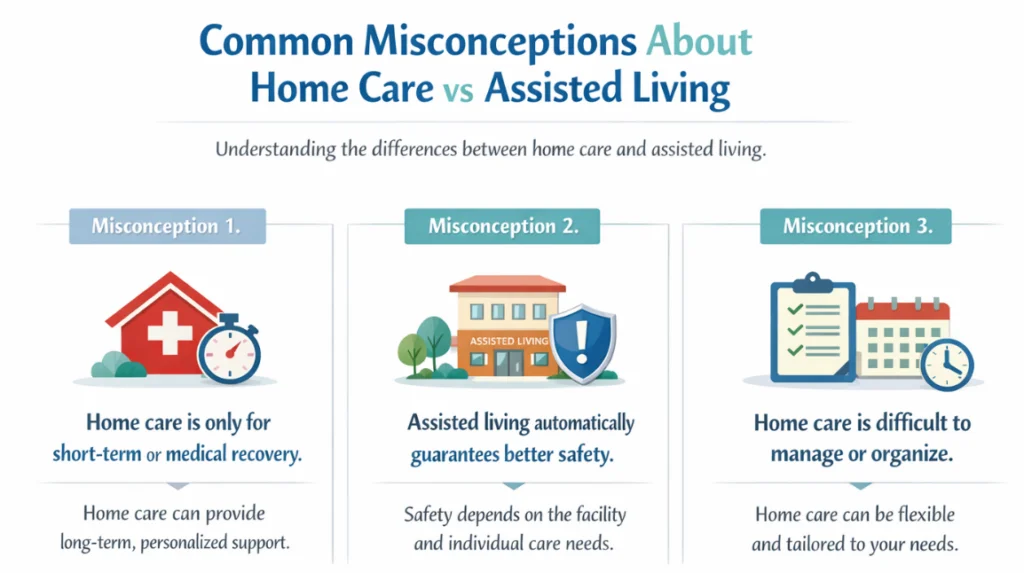
Misconception 1: Home care is only for short-term or medical recovery.
In truth, most home care is non-medical, designed to support long-term independence. It’s about practical help, trusted companionship, and continuity of routine — not clinical procedures.
Misconception 2: Assisted living automatically guarantees better safety.
Facilities are structured environments, but a thoughtfully arranged home can be just as safe. Simple modifications like improved lighting, grab bars, or rearranged furniture often address common risks. A consistent caregiver presence adds reassurance without relocation.
Misconception 3: Home care is difficult to manage or organize.
Modern home care agencies remove the burden of logistics. They handle scheduling, backup coverage, and compatibility — allowing families to enjoy the benefits of care without becoming full-time coordinators.
The Overlooked Power of Flexibility
Life rarely follows a fixed plan, especially when it comes to aging or care. That’s where home care shines. Service hours can expand or shrink. Caregivers can be rotated to find the perfect fit. Even the type of support — from personal care to companionship — can evolve naturally without major disruptions.
Assisted living provides structure, which some families find comforting. But for those who prioritize adaptability and the ability to make changes without uprooting life, home care offers unmatched freedom.
Key Questions to Guide Your Decision
If your family is weighing home care vs assisted living, ask these questions honestly:
- How much assistance does your loved one truly need each day or week?
- Would they feel happier and calmer staying in familiar surroundings?
- Can the home be adapted safely with minor improvements?
- How important is flexibility — financially and emotionally — for your family?
- What level of social interaction does your loved one genuinely enjoy?
Honest answers to these questions often point toward the right choice naturally, without forcing a decision.
Respecting Both Paths, Choosing What Fits Best
The truth is, neither option is “better†in all cases. Home care vs assisted living isn’t a competition — it’s about identifying which nurtures the most comfort, safety, and independence for your loved one.
Assisted living can be a wonderful community solution for those who need structure and social engagement. Yet for many families, non-medical home care remains the gentlest and most personal path — one that preserves home life, strengthens family bonds, and evolves as needs change.
If your family is exploring how professional caregivers can help your loved one live confidently and safely at home, considerANN&AGNES Homecare Agency. Their team provides compassionate, non-medical home care tailored to individual needs — supporting independence, comfort, and peace of mind for your entire family.